What Does “Accurate Data” Really Mean in 2026
When you’ve been in the insurance industry as long as I have—over 25 years—you start to notice something: nothing impacts your recruiting and outreach more than the accuracy of your data. I’ve built lists, cleaned lists, and used them every week while recruiting thousands of agents before I sold my agency. And now, helping others recruit and access affordable data, I see the same problem over and over again: some lists look great on the surface… but fall apart when you actually use them.
So let’s talk honestly about how accurate insurance agent lists really are in 2026, how I personally clean and verify mine, and what you should expect before buying a list—no hype, no fake promises, just real experience.
If you want to see how many agents are in each state, you can check here:
👉 State Counts
If you want to buy a list or request a sample, you can do that at the bottom of almost any page on my site:
👉 Store
Why Accuracy Is Everything in 2026
The insurance industry changes fast. Agents switch carriers, stop producing, move to new cities, change email addresses, or leave the business entirely. If your list isn’t updated or properly cleaned, your outreach suffers.
Here’s what inaccurate data leads to:
- High bounce rates
- Wasted money
- Damaged email reputation
- Low response rates
- Wrong types of agents
- Time lost talking to inactive producers
I’ve seen agencies sink hours into campaigns that never had a chance—simply because they started with bad data. That’s why accuracy matters more today than ever.
How I Verify and Clean Every List Before I Use It
I don’t use any list “as-is.” Not even my own. Before I email anyone, I run every dataset through multiple layers of verification. Here’s what that looks like:
1. I verify every email using a professional email-cleaning tool
Every list goes through a verification service that identifies:
- Bad emails(bounces)
- Risky emails(catch-alls, unverified mailboxes, temp emails)
- Good emails
On most state lists, I see:
- 3–5% bad emails
- 10–18% risky emails
Both categories get removed before I use the list.
This is normal. And this is why I never pretend email lists are “100% accurate”—because accuracy is a moving target in a fast-moving industry.
2. I confirm license status through state insurance departments
I don’t rely on one single source. I pull from:
- State licensing boards
- CE companies who legally sell updated data
- Other industry-trusted sources
License information is matched, cleaned, and confirmed to ensure that each agent:
- Is licensed in that state
- Has a valid NPN
- Has known Lines of Authority
- Is listed as active or inactive
One important note: Active license status does not mean the agent is actively producing. Thousands of licensed agents aren’t writing business. I always explain this upfront because it sets the right expectations.
3. I check Lines of Authority (LOA)
This is huge for recruiters. LOA shows whether an agent sells:
- Life
- Health
- P&C
- Medicare
- Or multiple categories
LOA matters because it determines who can sell what. Good lists always include this.
4. I remove expired agents and suspended licenses
I remove all:
- Expired licenses
- Suspended licenses
- Revoked licenses
- Retired agents
You should never waste time contacting someone who can’t legally write business.
5. I remove duplicates and normalize the data
Duplicates happen because agents hold multiple licenses or appear in multiple datasets. I normalize:
- Name formatting
- Address fields
- Organization names
- Phone formats
- Email structures
This makes the list cleaner and easier to use.
What’s Actually Included in Each List?
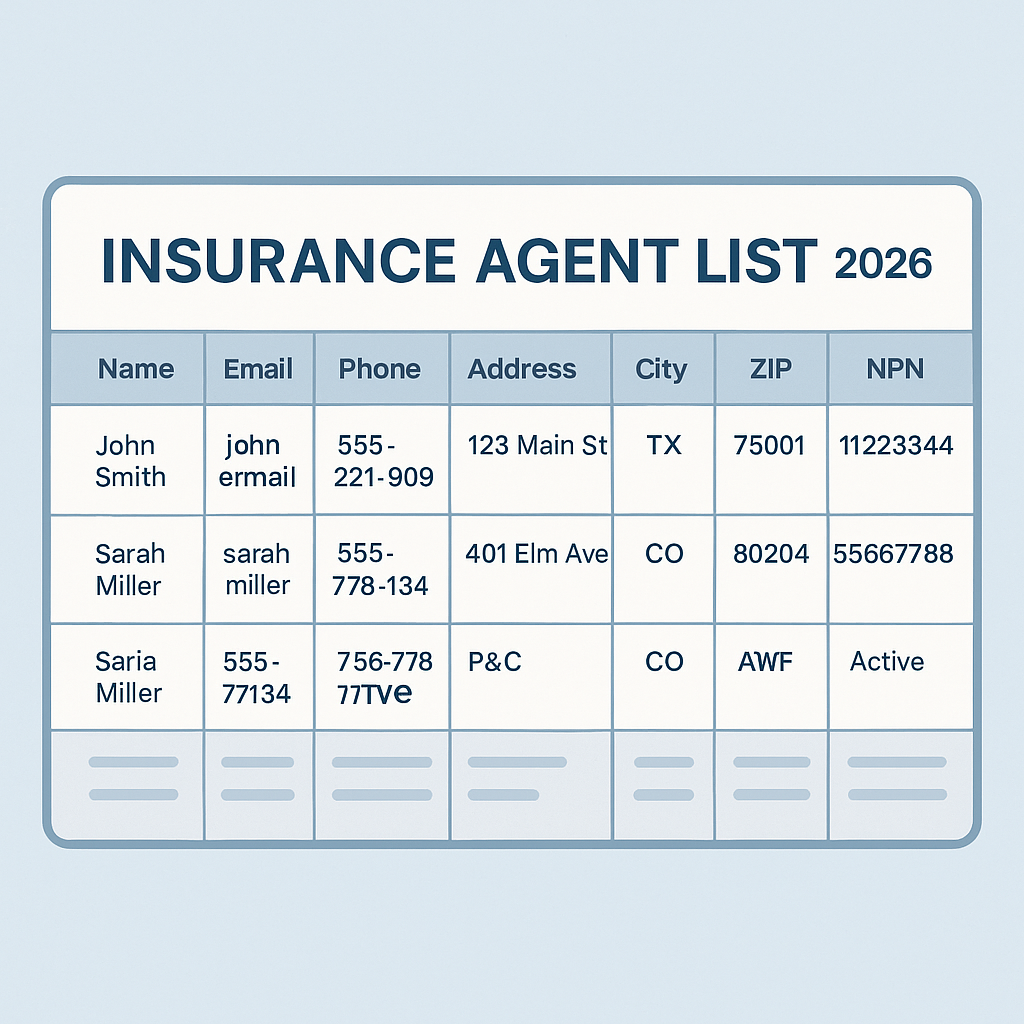
Here are the fields that are always included:
- NPN
- Name
- License type / Lines of Authority
- Email (80–90% coverage)
- Phone number (80–90% coverage)
- Mailing address (80–90% coverage)
- State, city, ZIP
- License status
Why Accuracy Varies by State
Here’s a simple visual showing how accuracy trends based on state size:
State Size Accuracy Levels (Typical Ranges)
Large States (CA, TX, FL)      | ███████████  Very High
Medium States (NC, CO, WI)     | ████████     High
Small States (VT, WY, ND)      | ████         Good
Larger states update their license data more frequently and more digitally, which helps accuracy.
How Often Are Lists Updated?
Once per year, every October.
This ensures the lists include:
- Newly licensed agents
- Removed agents who left the industry
- Updated addresses, phone numbers, and emails
- LOA and license status changes
The Truth About Email Accuracy in 2026
No list will ever be perfect — and that’s the truth most companies won’t tell you.
Agents constantly change email addresses because of:
- New carriers
- New agencies
- Domain changes
- Mailbox issues
- Job changes
- Retirement
But with proper cleaning, you should expect:
- Low bounce rates
- More replies
- Better deliverability
- Higher recruiting success
What You Should Expect When Using an Agent List
| Data Point | 2026 Expectation |
|---|---|
| Email Deliverability | 80–90% after verification |
| Phone Accuracy | 70–90% depending on state |
| Address Accuracy | 80–90% |
| License Status | Highly accurate (state-sourced) |
| Lines of Authority | Very accurate |
What I Won’t Do (And Why It Matters)
I don’t offer guarantees, inflated claims, or unrealistic promises. The insurance industry moves too fast for that. Being honest about accuracy builds trust—and trust leads to long-term results.
Who Benefits Most From Accurate Data?
This article is especially useful for:
- Insurance recruiters
- IMOs & FMOs
- Agencies building downlines
- Anyone needing B2B data
- Anyone doing cold email outreach
Final Thoughts
After working with data and recruiting agents for more than 25 years, I’ve learned one thing: accurate lists save time, save money, and get better results. When you combine verified contact information with updated license data, your recruiting and outreach become smoother and much more predictable.
If you want to buy an updated 2026 list or request a sample, you can do that here:
👉 Store
If you want to see how many agents your state has:
👉 State Counts